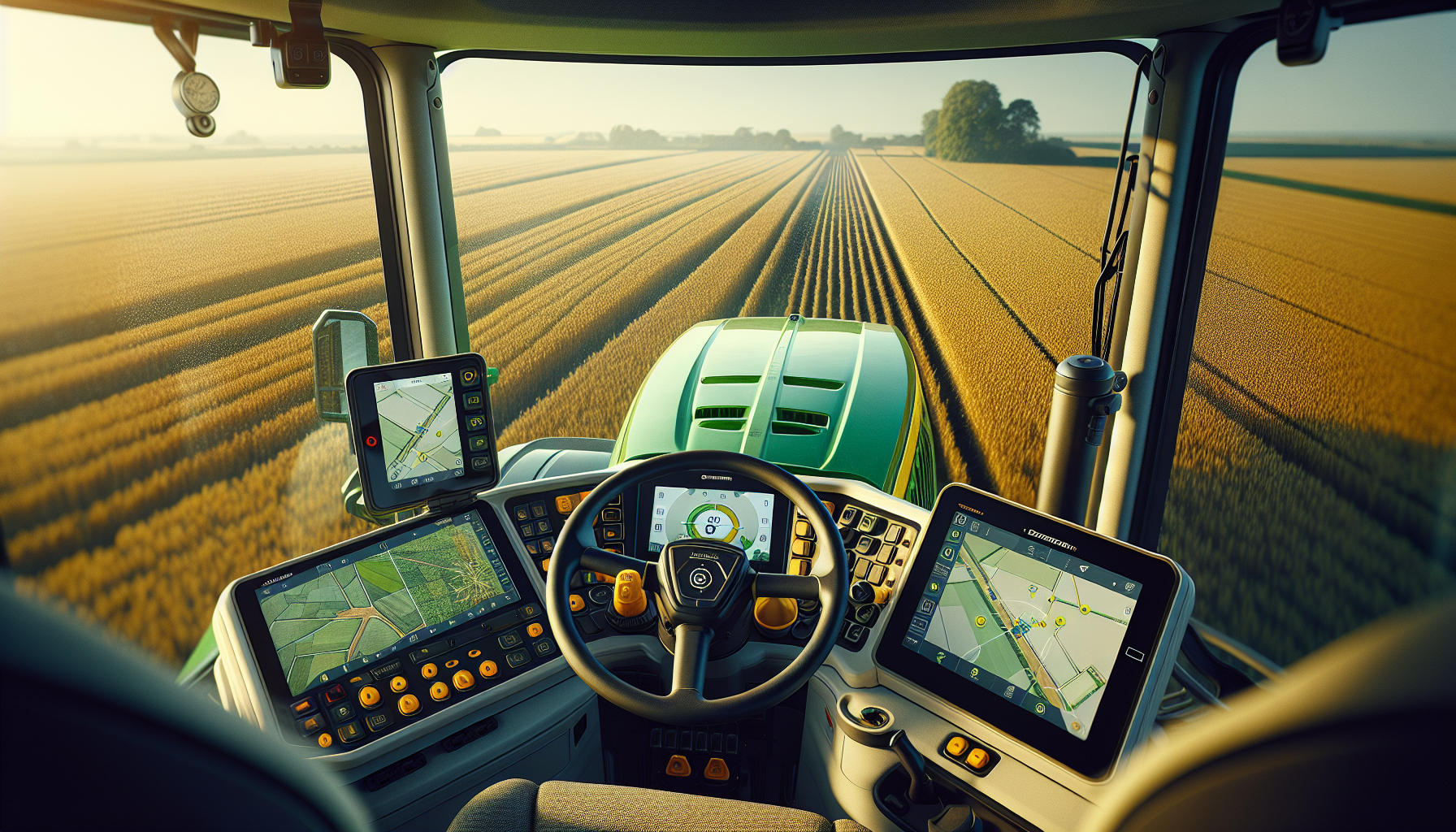
Walk into the cab of a modern CLAAS LEXION or John Deere S-Series combine on an East Anglian harvest field and the first thing you notice is the screens. Two, sometimes three, displaying yield maps, moisture readings, GPS positioning, and engine diagnostics in real time. The operator's hands may not even be on the wheel. Auto-steer has been guiding combines and tractors along centimetre-accurate tramlines across this region for over a decade.
But what is changing now, rapidly and irreversibly, is the intelligence behind those screens. Machine learning models that can distinguish a blackgrass seedling from a wheat tiller. Satellite imagery processed overnight to flag a patch of take-all in a 200-hectare field. Variable rate controllers that adjust seed, fertiliser, and spray rates on the fly based on prescription maps built from soil conductivity scans, yield data, and drone imagery.
This is not a technology pitch. It is a field report on what is actually running on farms today, what the economics look like, and what is genuinely coming next, written for the progressive farm manager who needs to decide where to invest.
What AI is already inside the combine and tractor cab?
The largest machinery manufacturers have been embedding increasingly sophisticated automation into their platforms for years. What has changed in the last three to four seasons is the step from automation (do the same thing, more precisely) to intelligence (observe conditions and adapt in real time). Understanding what each manufacturer offers helps cut through the marketing noise.
John Deere: the most aggressive AI play in agriculture
Deere has invested more heavily in agricultural AI than any other machinery manufacturer. Their acquisition of Blue River Technology in 2017 for USD 305 million signalled a strategic commitment that has since produced commercial products.
See and Spray Ultimate is Deere's flagship computer vision product. Mounted on the 400 and 600 Series sprayers, it uses 36 cameras running at 1.2 billion pixels per second to identify weeds in real time and trigger individual nozzles. In fallow ground, Deere claims a 77% reduction in herbicide use. In-crop performance depends on weed species and growth stage, but even 40-60% reductions are transformative economics when a typical broadacre herbicide programme costs GBP 80-120 per hectare.
AutoTrac is Deere's auto-steer platform and is probably the single most adopted piece of precision ag technology in East Anglia. It uses RTK GPS correction (StarFire 6000 receiver) to achieve 2.5cm pass-to-pass accuracy. On a 12-metre drill or a 36-metre sprayer, eliminating the 8-10% overlap that comes with manual steering saves real money: GBP 6-12 per hectare in input savings alone, plus the ability to work longer hours without fatigue-related drift.
Active Yield is the combine-mounted system that measures grain mass flow with improved accuracy over traditional impact sensors. When combined with HarvestSmart automation (which adjusts ground speed, fan speed, and sieve settings automatically), the operator becomes more of a process manager than a machine driver. The combine adjusts itself based on what it is sensing in the crop.
Autonomous tractor: Deere demonstrated its fully autonomous 8R tractor at CES 2022 and has been running limited commercial pilots since 2024. Six pairs of stereo cameras give 360-degree obstacle detection. The tractor can be started from a phone, monitored remotely, and will stop itself if it detects an unexpected obstacle. UK commercial availability is still limited, partly by regulation and partly by Deere's phased rollout, but it is real hardware running in real fields in the US.
CLAAS: the East Anglian standard
CLAAS has a dominant position in the East Anglian combine market. The LEXION range, particularly the 8000 and 7000 series, is the default choice on many large arable farms from Norfolk to Lincolnshire. Their AI story is less flashy than Deere's but arguably more immediately practical.
CEMOS (CLAAS Electronic Machine Optimisation System) is the base-level optimisation platform that recommends combine settings based on crop type, moisture, and throughput. It has been available for several seasons and most operators are familiar with it.
CEMOS AUTO is the step change. Introduced on the LEXION 8900-7400 range, it takes CEMOS from advisory to autonomous. The combine continuously adjusts fan speed, upper and lower sieve openings, and rotor/concave settings based on grain quality sensors and throughput. In variable crops, which is the norm across East Anglia where you might go from heavy wheat on clay to lighter crop on chalky knolls within one field, CEMOS AUTO adjusts faster than any operator could manually. Operators consistently report 3-7% throughput improvements and reduced grain losses.
CLAAS AUTO PILOT (GPS steering) and CRUISE PILOT (throughput-based speed control) work together so the combine maintains target throughput regardless of crop variability. On a 40ft header cutting variable winter wheat, this means the combine speeds up through thin patches and slows through heavy areas, maintaining consistent sample quality and reducing losses.
CNH Industrial: Case IH and New Holland
CNH's precision ag platform, AFS (Advanced Farming Systems), spans both Case IH and New Holland brands. The AFS Connect telematics platform provides remote monitoring, machine diagnostics, and fleet management. On the sprayer side, CNH's partnership with Raven Industries (acquired in 2021 for USD 2.1 billion) brought autonomous technology in-house.
The Case IH Trident 5550 applicator with Raven's DOT autonomous platform represents CNH's autonomous play. Raven's OMNiDRIVE technology, which allows a driver to control a tractor remotely from the combine cab during harvest, is commercially available and in use on UK farms for grain cart work.
New Holland's IntelliSense combine automation is their equivalent to CEMOS AUTO, using sensors to optimise threshing and cleaning in real time on the CR and CX range combines.
AGCO: Fendt and Massey Ferguson
AGCO's premium brand Fendt has a strong following among large arable operations, particularly in the tractor segment. The Fendt IDEALharvest system on their IDEAL combine range uses a camera-based grain quality system to monitor broken grain, automatically adjusting rotor speed and concave clearance.
AGCO's more experimental work includes the Xaver concept, a swarm of small autonomous electric robots designed for precision seeding. Each unit is roughly 50kg and plants individual seeds at variable rates. It remains a research concept rather than a commercial product, but it points to a future where large single machines give way to fleets of small autonomous ones.
The adoption picture in East Anglia: Auto-steer is estimated to be running on 70-80% of large arable operations (broadly, farms over 400 hectares) across Norfolk, Suffolk, Cambridgeshire, and Lincolnshire. Yield mapping is similarly widespread. The step to autonomous optimisation (CEMOS AUTO, HarvestSmart, IntelliSense) is still early, perhaps 30-40% of combines on progressive farms. The gap between what is available and what is deployed remains substantial.