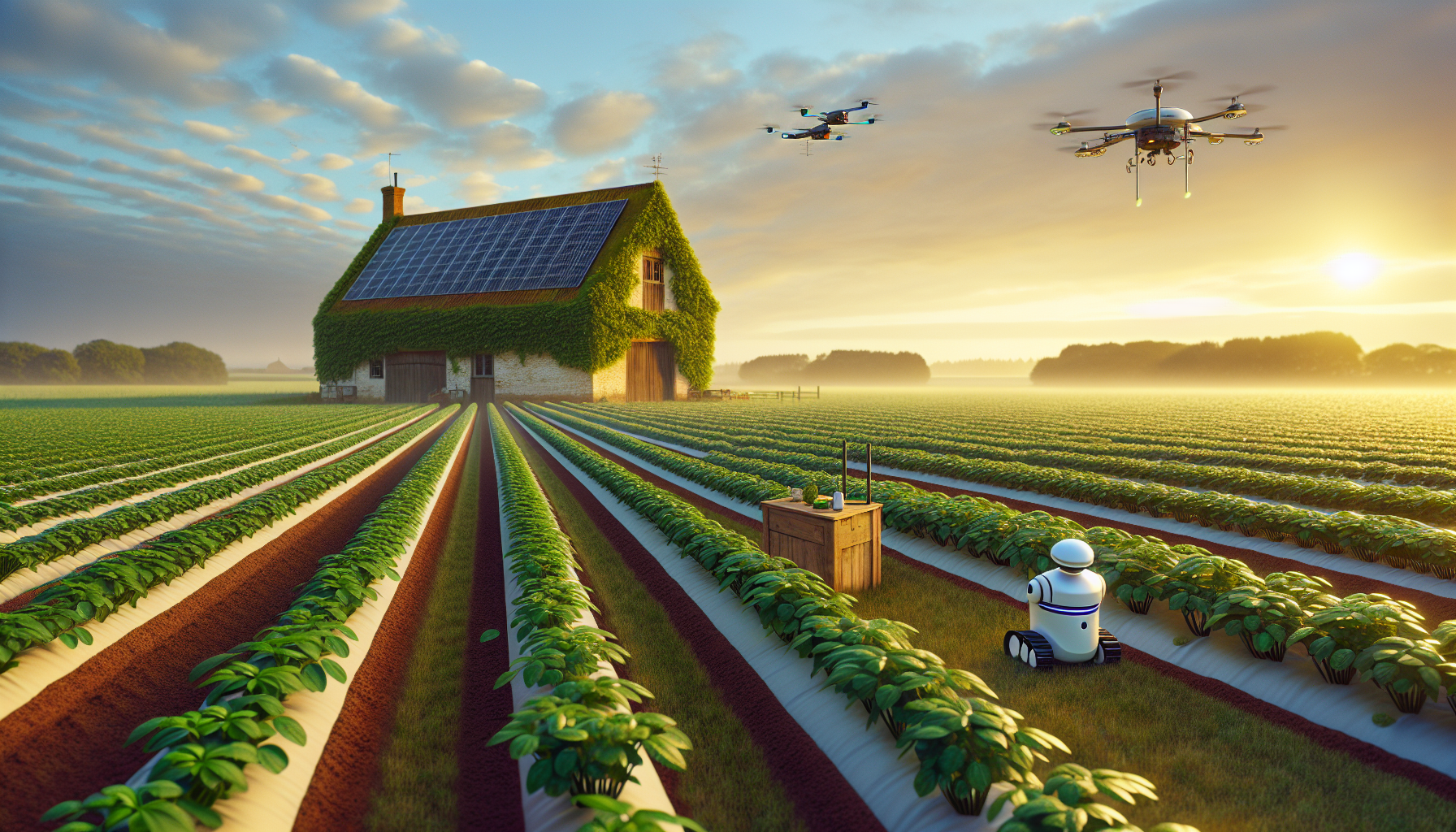
There is a particular kind of optimism in farming that has nothing to do with naivety. It is the optimism of someone who plants a crop knowing that weather, markets, disease, regulation, and sheer bad luck could all conspire against them, and does it anyway. That same optimism is what makes the best farmers natural adopters of technology. Not because they love gadgets, but because they are always looking for an edge.
The next five years will deliver more change to British agriculture than the previous twenty. That is not marketing language. It is the convergence of several forces happening simultaneously: the phase-out of direct payments, the introduction of outcome-based environmental schemes, legally binding net zero commitments, commercial availability of autonomous machinery, and AI that can actually interpret complex biological systems. Any one of those would reshape the industry. All of them together will transform it.
This page is an attempt to separate what is real from what is speculative, what is imminent from what is distant, and what matters to a working farm from what only matters to a conference keynote. It is written for the farmer, the farm manager, and the land agent who need to make investment decisions in the next two to three years, not the next twenty.
What does a UK farm look like in 2030?
The honest answer is: it depends entirely on which farm you are talking about. The variation between a progressive 3,000-acre East Anglian estate and a 200-acre mixed farm in Devon will be wider in 2030 than it is today. Technology does not homogenise farming. It amplifies existing differences in scale, capital, knowledge, and ambition.
But we can be specific about the technology trajectory, because most of it is already in development or field trial.
Near-term: 2025 to 2028
This is not the future. This is now, plus incremental improvement. The technologies that will define the next three years are already commercially available or in late-stage trials:
- Decision support tools become standard on farms over 500 acres. Platforms integrating weather, soil moisture, satellite imagery, and crop growth models to recommend spray timings, fertiliser rates, and drilling dates. Not replacing the agronomist, but giving them better data to work with.
- Variable rate application (VRA) moves from early adopter to mainstream for combinable crops. The economics are now unarguable on most arable operations over 200 acres: typical seed savings of GBP 8-15/ha, fertiliser savings of GBP 15-30/ha, with total input cost reductions of 10-18%.
- Weed detection and spot-spraying reaches commercial scale. Systems from the likes of Bilberry (already on Amazone sprayers) and crop.zone (electrical weed control) move from novelty to standard specification. Herbicide reductions of 60-90% are consistently demonstrated in trials.
- Disease prediction AI matures. Models trained on decades of weather, spore, and infection data provide 7-14 day advance warning of septoria, rust, and other fungal diseases. The shift from calendar spraying to evidence-based spraying saves 1-2 fungicide applications per season at GBP 25-40/ha each.
- Voice-controlled field recording allows operators to dictate observations from the tractor cab, crop walking notes spoken into a phone, with AI structuring the data for the agronomist or farm management software. This sounds minor. It is not. The gap between what farmers observe and what gets recorded is one of the biggest data losses in agriculture.
Medium-term: 2028 to 2032
This is where genuine transformation begins, but with important caveats about the UK context.
Autonomous tractors for routine field operations. John Deere's autonomous 8R is already in commercial use in the US. By 2028-2030, expect autonomous or semi-autonomous operation for tillage, drilling, and spraying on large, open fields in the UK. The technology works. The constraints are regulatory (who is liable when an autonomous machine crosses a public right of way?), insurance (underwriting frameworks do not yet exist), and practical (UK fields are smaller, more irregular, and more bounded by hedgerows than the US Midwest). The realistic UK timeline is 2-3 years behind the US, with initial adoption on farms over 1,000 acres with simple field geometry.
Digital twins. The concept of a digital twin, a real-time virtual model of the entire farm integrating soil maps, drainage records, weather stations, machinery telemetry, financial data, satellite imagery, and crop models, moves from research project to commercial product. The farm office becomes a control room. The value is not any single data source but the integration: being able to see that a yield drop in one corner of a field correlates with a drainage issue identified three years ago, compounded by a compaction event from last harvest's wet conditions. No human can hold all of that in their head. AI can.
Robotic soft fruit harvesting reaches commercial scale. This matters enormously for UK horticulture, which has faced chronic labour shortages since 2016. Companies like Fieldwork Robotics (University of Plymouth spin-out) and Dogtooth Technologies (Cambridge) are demonstrating picking rates that approach, though do not yet match, human speed. By 2030, expect robotic harvesting to be commercially viable for strawberries, raspberries, and tomatoes. Not cheaper than human labour at first, but available, which is the point when you cannot recruit enough seasonal workers at any price.
Longer-term: 2032 to 2035
AI-driven crop rotation that factors carbon sequestration, biodiversity credits, commodity markets, climate projections, and soil biology into multi-year rotational planning. The rotation becomes a financial instrument, optimised for total value rather than just yield.
Predictive harvest scheduling coordinated with the downstream supply chain. The combine knows when the grain will be ready. The dryer knows when the combine will deliver. The merchant knows when the grain will be available. The logistics are optimised end-to-end, reducing waste, drying costs, and quality losses.
What is NOT credible
Some things you will see in conference presentations and investment decks that are not going to happen in this timeframe, and possibly not in any timeframe:
- Fully autonomous farms with zero humans. Farming involves too many unstructured decisions, too many edge cases, and too much biological variability. AI augments human judgement. It does not replace it.
- AI replacing agronomists. AI will make good agronomists better and expose poor ones. But the relationship between farmer and adviser is built on decades of trust, local knowledge, and the ability to walk a field and know what you are looking at. No model replicates that.
- Universal adoption by 2035. A significant proportion of UK farms, perhaps 30-40%, will still be operating with minimal technology in 2035. Some by choice, some by lack of capital, some by lack of connectivity. That is reality, not failure.
Who is already doing this in Norfolk and East Anglia?
East Anglia is where British precision agriculture was born, and it remains the region where adoption is highest. The reasons are structural: large, flat, open fields suited to GPS-guided operations; predominantly arable rotations where input costs are high and marginal gains are measurable; a concentration of agricultural research institutions; and a culture of progressive farming driven by thin margins on combinable crops.
Hands Free Hectare and Hands Free Farm, Harper Adams
The project that proved autonomous arable farming works in the UK. Starting in 2016, a team at Harper Adams University in Shropshire (with significant East Anglian connections) grew spring barley using only autonomous machines. First-year yield: 4.5 tonnes per hectare, respectable for a proof of concept. The project has since expanded to the Hands Free Farm, running a full arable rotation autonomously across 35 hectares. The significance is not the yield. It is the demonstration that the technology chain, from planting through spraying through harvesting, can operate without a human in the cab.
Elveden Estate, Thetford
One of the largest farming operations in East Anglia at approximately 10,000 acres, Elveden has been an early and consistent adopter of precision technology. Working with SOYL (part of Frontier Agriculture), the estate was among the first in the UK to implement variable rate seed, fertiliser, and spray applications across its entire arable area. The scale makes the economics compelling: a 5% reduction in nitrogen costs across 10,000 acres saves more in a single season than the entire technology investment.
Holkham Estate, North Norfolk
A 25,000-acre estate that has become a leader in natural capital mapping and environmental technology. Holkham has invested in drone survey capability for both crop monitoring and ecological assessment, producing detailed habitat maps used for both ELMS applications and internal decision-making. Their approach integrates production agriculture with conservation, using technology to demonstrate that the two are not in conflict.
Frontier Agriculture and SOYL
The UK's largest crop input and grain marketing business, with data from millions of UK acres. SOYL's precision farming services, including soil scanning, satellite monitoring, and variable rate plans, are used across East Anglia and beyond. They represent the commercial infrastructure through which most UK arable farmers access precision technology. Their dataset is, in aggregate, one of the most valuable agricultural data assets in the country.
NIAB, Cambridge and Morley (Norfolk)
The National Institute of Agricultural Botany operates research stations at Cambridge and at Morley in south Norfolk, conducting trials on varieties, agronomy, and technology. The Morley site runs large-scale field trials that directly inform commercial farming decisions in the region. NIAB's work on disease resistance, agronomy optimisation, and digital tools bridges the gap between academic research and farm practice.
Bayer Forward Farm, Bourn, Cambridgeshire
A commercial farm operated as a demonstration and research site by Bayer CropScience, testing integrated crop management approaches including precision application, biological crop protection, and digital decision support. The farm provides real-world performance data under commercial conditions, not just trial plot results.
The scale challenge
Every example above is a large operation. Elveden farms 10,000 acres. Holkham manages 25,000. Even the Hands Free project has the backing of a university. The unresolved question in UK agri-tech is how to make these technologies accessible and economic for the 300-500 acre farm that represents the majority of English arable holdings. The technology works at scale. Making it work at moderate scale, without a full-time data analyst on the payroll, is where the real opportunity lies.
How does the UK compare internationally?
It is useful to benchmark, not to feel inadequate, but to understand where the UK has genuine advantages and where it needs to catch up.
United States
Autonomous machinery, scale-driven precision, USD 5B annual VC
UK 3-5 years behindNetherlands
Precision horticulture, robotic dairy, farmer data cooperatives
UK behind on adoptionIsrael
Drip irrigation AI, water management, military-to-ag pipeline
UK comparable (different focus)Australia
Broadacre GPS adoption, remote sensing, satellite connectivity
UK ahead on researchUnited States
Bigger fields, bigger machines, bigger data. The US is 3-5 years ahead on autonomous machinery adoption, driven by field sizes that make the economics obvious (a 2,000-acre Iowa corn farm has very different cost-per-acre calculations than a 400-acre Norfolk wheat farm). John Deere's ecosystem dominance means most US precision agriculture runs through a single technology stack. The US also benefits from a VC market that invested approximately USD 5 billion in agri-tech annually from 2020-2024, dwarfing UK investment.
Netherlands
The world leader in precision horticulture, greenhouse automation, and robotic dairy. Wageningen University and Research is the global centre of agricultural technology research. Dutch dairy farms routinely use robotic milking (over 30% of the national herd). Greenhouse operations in the Westland use AI-controlled climate management to achieve yields per square metre that are 5-10 times higher than open field equivalents. The Netherlands also has stronger data cooperatives: farmer-owned organisations that pool data for collective benefit, a model the UK has been slow to replicate.
Israel
A military-to-agriculture technology pipeline that has produced world-leading capabilities in drip irrigation, water management, and remote sensing. Netafim, the drip irrigation company, now deploys AI-driven irrigation scheduling that optimises water use to within 2-3% of plant requirement. Israeli agri-tech startups have raised billions in venture capital, with a disproportionate number focused on water scarcity, a problem the UK has not historically faced but may increasingly need to address.
Australia
Broadacre farming on a scale that makes even the US look modest. Australian adoption of GPS auto-steer, yield mapping, and remote sensing is among the highest in the world, driven by vast distances, thin margins, and the practical reality that you cannot scout a 50,000-acre station on foot. The technology decisions are different (satellite connectivity over cellular, long-range autonomy over short-field precision) but the mindset is transferable.
Where the UK leads
- Regulatory drivers. ELMS and Net Zero targets create stronger incentives for technology adoption than exist in any other major farming nation. The US has no equivalent of outcome-based environmental payments.
- Research quality. Rothamsted Research (the world's oldest agricultural research station, Hertfordshire), NIAB, the John Innes Centre (Norwich), and Scottish crop and animal research institutes collectively represent a research infrastructure that punches well above the UK's weight.
- Mixed farming complexity. UK farms are, by global standards, extraordinarily complex: mixed rotations, livestock alongside arable, environmental schemes, diversified enterprises. Technology that can integrate all of this has global export potential, because if it works in the UK it will work anywhere.
Where the UK lags
- Adoption rate. Research is strong. Translation to commercial adoption is weak. The "valley of death" between trial results and farm practice is wider in the UK than in the US, Netherlands, or Australia.
- VC investment scale. GBP 100-200 million per year in UK agri-tech VC, versus USD 5 billion in the US. The UK produces good science and loses the commercial opportunity to better-funded competitors.
- Data infrastructure. No national soil database of sufficient resolution. No standardised machinery data interchange format. No farmer-owned data cooperative at scale. These are infrastructure gaps, not technology gaps.
- Rural connectivity. Approximately 11% of rural premises in England cannot get 10 Mbps broadband. You cannot run a digital twin on a 3G connection. The Shared Rural Network will help, but full 4G coverage is not expected until 2028-2030.
What is the investment landscape for agri-tech?
Money follows opportunity, and agri-tech is attracting significant capital, though the distribution is uneven and the failure rate is high.
Venture capital
UK agri-tech attracted an estimated GBP 500-700 million in venture capital between 2020 and 2025. Key investors include Yield Lab Europe (dedicated agri-food VC), Wheatsheaf Group (Grosvenor family's food and agriculture investment arm), and Syngenta Ventures (the corporate VC arm of the agrochemical giant). International funds including Anterra Capital and S2G Ventures have also made UK investments.
Where the money goes
Billions at the top. Hundreds per month at the farm gate. The gap is the opportunity.
Notable funding rounds
| Company | Focus | Funding | Status |
|---|---|---|---|
| Intelligent Growth Solutions (IGS) | Vertical farming | GBP 42M+ | Restructured 2024 |
| RootWave | Electrical weed control | GBP 8M | Commercial trials |
| Small Robot Company | Autonomous agri-robots | ~GBP 10M | Restructured |
| Hummingbird Technologies | AI crop analytics | GBP 10M+ | Acquired by Relate (2023) |
| Fieldwork Robotics | Fruit picking robots | GBP 3M+ | Field trials |
The pattern is instructive. Hardware-heavy startups (IGS, Small Robot Company) have struggled. The capital requirements are enormous, the development cycles are long, and the path to profitability is uncertain. Software and data platforms, while less exciting to headline writers, have better unit economics and faster adoption curves.
Government funding
The UK government has committed significant public funding to agri-tech:
- UKRI Transforming Food Production: GBP 90 million across multiple research and innovation projects
- Defra Farming Innovation Programme: GBP 270 million (2021-2029) for farmer-led R&D, feasibility studies, and innovation partnerships
- Farming Equipment and Technology Fund (FETF): Grants of GBP 1,000-25,000 for specific equipment purchases, including precision technology
- Innovate UK: Regular competition rounds for agri-tech projects, typically GBP 50,000-500,000 per award
The investment thesis
The compelling investment case for UK agri-tech is not "farming needs to be more efficient" (true but vague). It is specific: UK farming faces a simultaneous withdrawal of direct subsidies, introduction of outcome-based environmental payments requiring data evidence, legally binding net zero targets, and chronic labour shortages. Technology is not optional in that context. It is structural. The question is not whether the market exists but who captures it.
The less compelling aspect: agriculture is slow. Purchasing cycles are annual. Trust is built over years. A SaaS company selling to tech startups can close a deal in a week. A SaaS company selling to farmers might wait until Cereals, get a trial the following season, and close the deal the season after that. Investors expecting software-typical growth rates in agriculture will be disappointed.
What is the real opportunity for Norfolk farmers right now?
The macro picture is interesting. The question that matters to anyone reading this in Fakenham or Diss or Bury St Edmunds is: what should I actually do?
The opportunity gap
There are approximately 3,000-4,000 arable farms over 200 acres in East Anglia. The majority collect data, often without realising it: yield monitors in combines, GPS tracks in auto-steer systems, soil sample results in filing cabinets, weather observations in the farmer's head. Very few act on that data systematically. The gap between data collection and data-driven decision-making is the biggest untapped opportunity in UK arable farming.
The missing piece is not more data. It is integration: pulling information from machinery telemetry, weather services, satellite imagery, soil analysis, and farm financials into a single view that supports better decisions. Not replacing the farmer's judgement, but informing it with everything available rather than just what they can remember.
Practical applications available today
Voice-controlled field reporting. Farmers spend hours every week observing crops, soil conditions, weed pressure, pest activity, and machinery performance. Almost none of it gets recorded in a usable format. A simple voice interface, dictate observations from the cab, AI structures and categorises them, they appear in a dashboard the agronomist can access, would transform the quality of agronomic advice. The technology exists. The product barely does.
Spray window calculators. The decision of when to spray involves wind speed, temperature, humidity, crop growth stage, disease pressure, withdrawal periods, and the availability of machinery and labour. Most farmers make this decision based on experience and a weather forecast. AI can integrate all variables and identify optimal windows 5-7 days in advance, including calculating the cost of missing a window (in terms of yield loss) versus the cost of delaying other operations.
Grain marketing decision support. The timing of grain sales can swing farm profitability by GBP 10-30/tonne. Most farmers sell reactively, often at harvest when prices are lowest. AI models that integrate global supply/demand data, currency movements, local basis, and on-farm storage capacity to recommend sale timing could add GBP 5,000-20,000 per year to a 500-acre arable farm's bottom line.
ELMS compliance automation. The Sustainable Farming Incentive (SFI) and other ELMS options require evidence of actions and outcomes. Satellite imagery, soil sampling records, and field activity logs can automatically generate compliance evidence. What currently takes 2-3 days of paperwork could be reduced to 20 minutes of review.
SFI evidence gathering. Specifically: automating the photographic evidence, management records, and outcome measurements that SFI requires. Geo-tagged photos from a phone, linked to field records, structured into the format Defra needs. This is not complex AI. It is sensible data management. But it would save every farm in an SFI scheme significant time and stress.
The economics
At GBP 200-500 per month for a SaaS platform, or GBP 5,000-15,000 for bespoke integration work, the tools described above would need to save a 400-acre arable farm approximately GBP 2,400-6,000 per year to break even. Given that fertiliser savings alone from variable rate application typically deliver GBP 6,000-12,000 annually on a farm of that size, the economics are not theoretical. They are demonstrated.
The real barrier is not cost. It is confidence: confidence that the technology will work reliably, that the data will be secure, that the system will not become another abandoned subscription. Building that confidence requires demonstration, not marketing. It requires other farmers saying "I use this, it works, here are my numbers."
How do you actually sell technology to a farmer?
This section exists because most technology companies get this catastrophically wrong, and their failure to understand farming culture is why adoption rates are lower than the technology deserves.
The trust chain
Farmers adopt technology through a specific hierarchy of trust, and it has not changed in decades:
Word-of-mouth from a respected peer outweighs every other channel combined.
- Other farmers they respect. This is overwhelmingly the most powerful channel. A farmer who says "I tried this on my bottom field and it saved me GBP 3,000 in nitrogen" is worth more than every trade advert ever printed. The specific farmer matters: it needs to be someone farming similar land, at similar scale, in similar conditions.
- Their agronomist. The independent agronomist, and to a lesser extent the Frontier or Hutchinsons rep, is the most trusted technical adviser. If the agronomist recommends a technology, it will be considered seriously. If the agronomist is sceptical, it is dead.
- Their machinery dealer. Particularly for hardware-adjacent technology (precision upgrades, auto-steer, yield mapping). The dealer relationship is long-standing and practical: they service the machines, they understand the operation, they are local.
- Industry press and events. Farmers Weekly, Farmers Guardian, CPM Magazine, and events like Cereals (near Duxford in East Anglia), Groundswell, LAMMA, and the Royal Norfolk Show are where new technology gains visibility. A live demonstration at Cereals is worth a hundred webinars.
Language that works
Specific, practical, financial:
- "Save you 3 hours a day on paperwork"
- "Spot disease 10 days earlier than walking the field"
- "Cut your fertiliser bill by GBP 40 per hectare"
- "Get SFI evidence together in 20 minutes instead of 2 days"
- "Know your cost of production per tonne before harvest starts"
Language that kills adoption
- "Digital transformation." Means nothing. Sounds expensive.
- "Disruptive technology." Nobody who depends on their farm for their livelihood wants disruption. They want improvement.
- "Smart farming." The implicit corollary is that current farming is dumb. It is not. It is experienced, skilled, and operating under extraordinary constraints.
- "Big data." Farmers do not want big data. They want useful data. Preferably on a single screen they can check over breakfast.
- "AI-powered." Means nothing unless you explain what it does. "We use satellite imagery and weather data to recommend when to spray" is useful. "Our AI-powered platform leverages machine learning" is noise.
"Save you 3 hours a day on paperwork"
"Cut fertiliser costs by GBP 40/ha"
"Spot disease 10 days earlier than walking"
"SFI evidence in 20 minutes not 2 days"
"Digital transformation"
"Disruptive technology"
"Smart farming"
"AI-powered platform leverages big data"
The generational dynamic
The farms most receptive to technology are those in generational transition: typically where a 30-something has returned from a career elsewhere (often London, often in technology or finance) and is now running or co-managing the family operation alongside a parent in their 60s. The returning generation brings comfort with technology and impatience with "we've always done it this way." The older generation brings deep knowledge of the land, the local conditions, and what actually matters when the weather turns.
The best technology adoptions happen when both generations are engaged: the younger farmer drives implementation, the older farmer validates the output against decades of experience. The worst happen when technology is imposed without that validation, and the first time the AI gets something wrong that experience would have caught, trust is destroyed permanently.
Women in farming are consistently among the earliest technology adopters. Often managing the administrative, financial, and compliance side of the operation, they are the ones most directly exposed to the paperwork burden that technology can relieve. Any technology company ignoring women in its marketing and demonstration programme is leaving its best potential advocates on the table.
Mental health
This matters and it is rarely discussed in a technology context. Farming has one of the highest suicide rates of any occupation in the UK. The pressures are relentless: financial uncertainty, physical danger, isolation, regulatory burden, weather anxiety, and the weight of multi-generational expectation. Any technology that genuinely reduces stress, that takes away administrative burden, that provides financial clarity, that makes the job feel less overwhelming, is not just a commercial product. It is a contribution to wellbeing. This is not marketing sentiment. It is something the agri-tech sector should take seriously in how it designs, prices, and supports its products.
What does the regulatory landscape demand?
UK farming is facing a regulatory environment that is, without exaggeration, the most complex it has ever been. Understanding the regulatory drivers is essential to understanding why technology adoption is not optional but structural.
BPS phase-out
The Basic Payment Scheme, which paid farmers based on area farmed regardless of what they produced or how they managed the land, is being phased out. At its peak, BPS was worth GBP 1.8 billion per year to English farmers alone. By 2028, it will be gone. For many farms, BPS represented 50-100% of net profit. Its removal is the single largest financial shock to UK farming since the Second World War.
Environmental Land Management Schemes (ELMS)
The replacement for BPS is outcome-based. The Sustainable Farming Incentive (SFI), Countryside Stewardship, and Landscape Recovery schemes pay for environmental outcomes: improved soil health, reduced emissions, enhanced biodiversity, better water quality. The critical difference from BPS: these schemes require evidence. You cannot claim payment for improved soil health without demonstrating it. This is where technology becomes essential. Automated monitoring, satellite verification, and structured data collection are not just helpful for ELMS compliance. They are, increasingly, prerequisites.
Net Zero 2050
Agriculture accounts for approximately 10% of UK greenhouse gas emissions, primarily from livestock (methane) and fertiliser use (nitrous oxide). The sector has a legally binding obligation to contribute to the UK's Net Zero 2050 target. Precision application of fertilisers (reducing N2O emissions), optimised livestock management (reducing methane), and improved soil carbon sequestration all require data, measurement, and verification. Technology is the measurement infrastructure.
Pesticide reduction
While the UK has not adopted the EU's specific 50% reduction target, regulatory pressure on pesticide use is increasing. Active ingredient withdrawals continue (neonicotinoids, key herbicides). The direction of travel is clear: fewer chemicals, used more precisely. Precision spraying, biological alternatives, and integrated pest management all require technology support.
Biodiversity Net Gain
Since 2024, all planning permissions in England require a 10% Biodiversity Net Gain (BNG). Farms selling BNG credits to developers need baseline surveys, management plans, and ongoing monitoring. AI-powered ecological assessment, using drone imagery and species identification models, can reduce the cost and increase the accuracy of BNG monitoring.
Food security
The Agriculture Act 2020 introduced triennial food security reporting, acknowledging that domestic production matters. The UK currently produces approximately 60% of its food. Maintaining or increasing that while simultaneously reducing environmental impact is the central challenge. Only technology, specifically precision agriculture that produces more with less, addresses both objectives simultaneously.
The summary
UK farming faces subsidy withdrawal, outcome-based environmental payments, net zero obligations, pesticide reduction, biodiversity requirements, and food security expectations, all at the same time. There is no plausible scenario in which farms meet all of these demands without technology. The farms that recognise this now, that invest in data infrastructure and capability while the transition is still underway, will be positioned to capture the payments, meet the requirements, and maintain profitability. The farms that wait will face the same requirements with less time, less support, and a steeper learning curve.