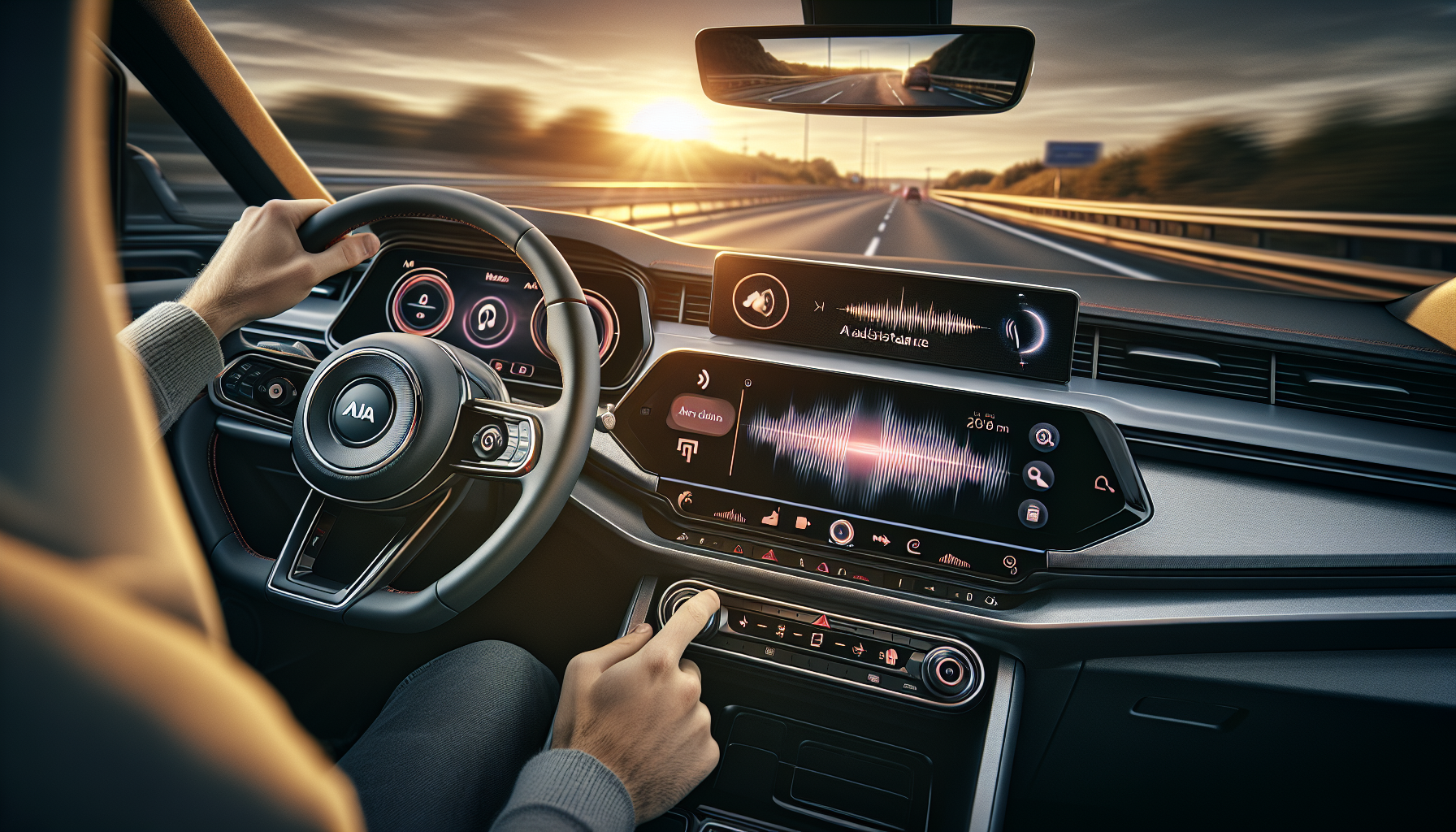
Every major car manufacturer is now racing to integrate large language models into their vehicles. Mercedes, Volkswagen, and Tesla have already shipped LLM-powered assistants, BMW and Hyundai are launching theirs in 2026, and Chinese manufacturers like NIO and XPeng are 2-3 years ahead. The car dashboard is transitioning from a passive display to an active, context-aware copilot, but the experience today is still far behind what standalone AI tools can deliver.
What can your car's voice assistant actually do today?
The honest answer: not nearly enough. In 2026, we have AI that can write code, compose music, and pass medical exams. Meanwhile, the voice assistant in most cars still struggles with "navigate to the nearest Costa that's open." The gap between what AI can do on your phone and what it can do in your car is enormous, and it comes down to two very different ecosystems fighting for the same dashboard.
The Apple CarPlay empire
Apple CarPlay is the dominant force in automotive infotainment. 98% of new cars sold today support it, and 83% of iPhone owners use it regularly. For most people, CarPlay is the car's operating system. The car's own system is what you see for the three seconds before your phone connects.
Apple launched CarPlay Ultra in May 2025, a next-generation version that takes over the entire instrument cluster, not just the centre screen. It renders the speedometer, tachometer, climate controls, and navigation across every display in the vehicle. The promise is a seamless Apple experience from the moment you sit down. But the rollout has been glacial. As of early 2026, only Aston Martin has shipped a vehicle with CarPlay Ultra. Porsche and several others have announced support, but volume production vehicles with the feature remain scarce. The automotive industry moves slowly. Apple moves fast. The mismatch is painful.
Android Automotive OS: Google's deeper play
While CarPlay mirrors your phone to the car's display, Google is playing a fundamentally different game. Android Automotive OS (AAOS) is not Android Auto. Android Auto mirrors. AAOS is a full operating system that runs natively on the car's hardware, built into the vehicle at the factory.
The difference matters. AAOS can control the climate system, adjust seat positions, manage vehicle settings, and integrate with the car's sensors in ways that a mirrored phone app never can. It runs Google Maps, Google Assistant, and the Play Store natively. Apps are designed for the car, not stretched from a phone screen.
Renault, GM, Ford, and Volvo have all adopted AAOS for their infotainment platforms. Volvo's EX90 runs it. The new Renault 5 runs it. GM controversially dropped Apple CarPlay entirely for its EVs, betting that a native Google-powered system is the future. Gartner projects that 80%+ of new cars will ship with Android Automotive by 2028.
The tension is clear. Apple wants to own the screen. Google wants to own the operating system. Car manufacturers are caught in between, and drivers are stuck with whichever side their manufacturer chose.
Why talking to your car is still painful
Regardless of platform, the voice experience in cars remains fundamentally broken. The reasons are technical, and they compound:
- Rigid syntax. Most systems still require specific phrasings. "Set the temperature to 21 degrees" works. "It's a bit cold in here" does not. Natural language understanding in cars is a generation behind what you get from ChatGPT or even Siri on your phone.
- No context retention. Say "navigate to Heathrow." Then say "actually, Gatwick instead." Most systems start over. They have no memory of the previous request, no concept of a conversation. Every utterance is treated as a standalone command.
- Latency. Humans expect conversational responses within 200-300 milliseconds. Current car voice systems typically respond in 500 milliseconds or more. That delay is enough to feel unnatural, and at motorway speed, it breaks the flow entirely. You end up waiting, wondering if it heard you, and eventually just tapping the screen.
- Noise degradation. Road noise, wind, passengers talking, music playing. In-cabin noise reduces voice recognition accuracy by 8-15% compared to a quiet room. Beamforming microphone arrays help, but they add cost and complexity.
- The 1-in-9 problem. Industry benchmarks put current automotive NLU (natural language understanding) at around 89% accuracy. That sounds good until you realise it means roughly 1 in 9 commands fails. At 70mph, a failed command is not just annoying. It is a safety issue. You glance at the screen, try again, lose focus. One failed interaction and you are back to tapping buttons.
The result is that most people use their car's voice assistant for exactly two things: making phone calls and setting navigation. Everything else, they reach for their phone. The in-car AI is furniture.
Which manufacturers are actually shipping AI?
The marketing around "AI in cars" is thick enough to cut with a key fob. Every manufacturer claims to have it. Far fewer have actually shipped anything meaningful. Here is what is real, what is announced, and what is vapourware.
| Manufacturer | AI System | Status | Key Details |
|---|---|---|---|
| Mercedes-Benz | MBUX + ChatGPT | Shipped 2024 | 3M vehicles. Deep MBUX integration with vehicle controls. First luxury OEM to ship. |
| Volkswagen | IDA + ChatGPT | Shipped Sept 2024 | ID family, Golf, Tiguan, Passat. Voice-first, handles general knowledge alongside vehicle commands. |
| Tesla | Grok | Shipped July 2025 | Companion app only for now. "Hey Grok" in-car activation coming Spring 2026. EU rollout 2026. |
| BMW | Alexa+ | H2 2026 | Announced CES 2026. Neue Klasse platform. Alibaba partnership for Chinese market. |
| Hyundai | Pleos Connect OS | Q2 2026 | Software-defined experience (SDx). Over-the-air vehicle personality updates. |
| GM | Google Gemini | 2025-2026 | Dropped CarPlay for native AAOS + Gemini. Massive backlash: 46% of shoppers say CarPlay is a must-have. |
| Rivian | AI Assistant | Delayed | Announced December 2025. Original target was early 2026. No confirmed ship date. |
| NIO | NOMI | Shipped 2017 | World's first mass-produced in-car AI. Physical robot avatar on dashboard. Emotional responses. |
| XPeng | VLA 2.0 | Shipping | AI-defined vehicle architecture. Licensing technology to Volkswagen. Vision-language-action model. |
The big bets: Mercedes and Volkswagen
Mercedes was the first luxury manufacturer to ship a real LLM integration. Their MBUX system, already one of the more capable infotainment platforms, gained ChatGPT-powered conversational abilities across 3 million vehicles in 2024. The integration goes beyond a chat window. It can combine general knowledge queries with vehicle controls, so you can ask "what's the best route to avoid the M25 closure, and can you warm up the seats?" in a single breath.
Volkswagen took a broader approach with IDA (Intelligent Digital Assistant), shipping ChatGPT integration in September 2024 across both its electric ID family and its mainstream ICE vehicles: the Golf, Tiguan, and Passat. This is significant because it puts LLM capability into the hands of volume buyers, not just luxury customers. When a Golf driver can talk to ChatGPT through their dashboard, the technology has crossed from novelty to normalisation.
The GM gamble
General Motors made what may be the most polarising decision in recent automotive history: dropping Apple CarPlay entirely from its electric vehicles, replacing it with a native Google-powered system running Gemini. The reasoning is understandable. If you build the OS into the car, you control the experience, the data, and the monetisation. CarPlay gives Apple all three.
The backlash has been fierce. 46% of new car shoppers say phone integration is a must-have feature, and for most of them, that means CarPlay. GM's bet is that a native AI experience will be good enough to justify the sacrifice. Early reviews suggest it is not there yet.
The Chinese advantage
Perhaps the most important row in that table is NIO. In 2017, when Western manufacturers were still debating whether to put Bluetooth in base models, NIO shipped NOMI: the world's first mass-produced in-car AI assistant. It has a physical robot avatar that sits on the dashboard, makes eye contact, and displays emotional responses. It was not a concept car demo. It shipped in production vehicles to paying customers.
XPeng has gone further with VLA 2.0, a vision-language-action model that treats the car as an AI-defined vehicle. The AI does not just talk. It perceives, reasons, and acts. XPeng is now licensing this technology to Volkswagen, which tells you everything about where the centre of gravity in automotive AI has shifted.
Chinese manufacturers are 2-3 years ahead of their Western counterparts. The competitive intensity of China's EV market, with over 100 brands fighting for survival, has created a pace of innovation that Europe and North America cannot match with their 4-5 year development cycles.
Manufacturer LLM Integration Timeline
2017
NIO NOMI - world's first mass-produced in-car AI
2024
Mercedes MBUX + ChatGPT (3M vehicles) / VW IDA + ChatGPT (Sept)
2025
Tesla Grok companion (July) / GM Gemini rollout / Rivian AI announced
2026 (we are here)
BMW Alexa+ (H2) / Hyundai Pleos Connect (Q2) / Tesla "Hey Grok" + EU / XPeng VLA 2.0 licensing
2027-2028
Gartner: 80%+ of new cars on Android Automotive / next-gen proactive assistants
What does the morning briefing look like?
Here is a scenario that every car manufacturer is working toward, and that none of them have shipped.
It is 7:45am. You sit down in your car. The seat adjusts to your morning position (slightly more upright than evening, because the system has learned the pattern). The cabin warms to 20 degrees because it checked the weather five minutes ago and started the climate while you were locking the front door.
Before you touch anything, the car speaks:
"Good morning. Your 9am with Sarah Chen has moved to 9:30. I've adjusted your route to avoid the A34 closure. You'll arrive at 9:12, so there's time for that coffee stop at the Costa on London Road you usually hit on Wednesdays. Also, it's James's birthday today. Want me to send a message?"
In that thirty-second briefing, the car has done six things: checked your calendar, detected a schedule change, read live traffic data, calculated a new route, remembered your routine, and cross-referenced your contacts. No voice command was needed. It was proactive.
This is the experience every manufacturer demos on stage. It is the experience none of them have delivered.
Who is building it?
Hyundai's SDx (Software-defined Experience) vision comes closest to articulating this as a product strategy. Their approach treats the car as a continuously evolving platform where over-the-air updates change not just features but personality. The car adapts to you, not the other way around. Pleos Connect OS, shipping Q2 2026, is their first implementation.
BMW's Alexa+ partnership, announced at CES 2026, focuses specifically on proactive intelligence. Amazon's pitch is that Alexa already knows your smart home devices, your shopping habits, your music preferences, and your calendar. Put that context in a car and the morning briefing practically builds itself. The Neue Klasse platform, shipping H2 2026, is the target.
Mercedes's next-generation MBUX is building on the ChatGPT integration to add what they call "anticipatory features," using driving patterns, calendar data, and vehicle telemetry to suggest actions before they are requested. The foundation is there. The 3 million vehicles with ChatGPT integration are the training ground.
Rivian's AI Assistant, announced in December 2025, promised a deeply integrated experience that understood trip context, vehicle capabilities (particularly for off-road scenarios), and personal preferences. It has been delayed, with no confirmed ship date, which tells you something about how hard this problem actually is.
The missing piece
Every individual component of the morning briefing exists today. Calendar integration works. Navigation is excellent. Traffic data is real-time. Weather is accurate. The problem is that these systems are siloed. Your calendar is in Google or Outlook. Your contacts are on your phone. Your smart home is on Alexa or Google Home. Your car is its own island.
The manufacturer that cracks this is not the one with the best voice recognition or the most powerful on-board chip. It is the one that builds a unified agent layer connecting your digital life to your vehicle context. That requires partnerships, APIs, and a willingness to let third-party data flow through the car's systems. It requires trust from both the user and the data providers.
BMW and Hyundai are closest, with 2026 and 2027 targets respectively. But closest is not there.
What does your car actually know about you?
A modern connected car generates approximately 25 gigabytes of data per hour from over 100 sensors. LiDAR, radar, cameras, wheel speed sensors, accelerometers, gyroscopes, GPS, tyre pressure monitors, engine temperature, oil pressure, brake wear, battery health (in EVs), cabin temperature, humidity, ambient light, microphones, and dozens more. Your car knows more about your physical environment than any other device you own.
The question is what gets done with that data. Today, most of it is discarded or stored in a black box that only the dealership can access during a service. AI changes that equation entirely.
Predictive maintenance
Traditional car maintenance runs on fixed schedules. Oil change every 10,000 miles. Brake pads inspected every 20,000. Timing belt at 60,000. This is crude. It means replacing parts that still have life in them, and occasionally missing failures that happen between service intervals.
AI-driven predictive maintenance analyses sensor data in real time to predict component failures before they happen. Current systems achieve 89% accuracy and can detect issues 20-45 days before failure occurs. A subtle change in brake pad friction signature. An engine vibration pattern that deviates from the learned baseline. A battery cell showing degradation faster than its neighbours.
For the driver, this means your car tells you "your rear brake pads will need replacing in about three weeks" rather than a warning light appearing on the motorway. For fleet operators, it means scheduling maintenance proactively instead of reactively, reducing downtime and avoiding roadside breakdowns.
The automotive predictive technology market is projected to reach $119 billion by 2030. The economic incentive is clear. A preventable breakdown costs an average of 5-10 times more than a scheduled repair when you factor in towing, rental cars, lost productivity, and the repair itself.
Driving style analysis
Your car knows how you drive. Acceleration patterns. Braking intensity. Cornering speed. Speed relative to limits. Following distance. Lane discipline. Every input you make through the steering wheel, pedals, and gear selection creates a fingerprint that is unique to you.
AI turns this fingerprint into actionable insight. Gentle driver in the morning, aggressive in the evening commute? The system notices. Harsh braking frequency increasing over the past month? It flags it. Driving efficiency dropping in winter? It can suggest tyre pressure adjustments or route changes.
Insurance telematics
The insurance industry has been the most aggressive adopter of in-car AI data. Telematics-based insurance (UBI, usage-based insurance) has reached 19% adoption in the UK market. The global market was valued at USD 2.4 billion and is growing to USD 6.9 billion by 2031.
The model is simple. Let the insurer see how you actually drive, and get a premium based on your real risk rather than your postcode and age bracket. Young drivers who drive carefully pay less. Older drivers who tailgate pay more. The data does not lie.
The technology has shifted from physical black boxes hardwired into the vehicle to app-based systems that use the phone's accelerometer and GPS. This has dramatically lowered the barrier to entry. No hardware installation, no dealer visit, just download an app and drive. Insurers like By Miles and Marshmallow have built entire businesses on this model.
Fleet management and agentic AI
For commercial fleets, in-car AI data enables a step change in operational efficiency. Route optimisation based on real-time traffic and delivery windows. Fuel consumption analysis by driver and route. Maintenance scheduling across hundreds or thousands of vehicles. Driver safety scoring and coaching.
The emerging frontier is agentic AI for fleet management: systems that do not just report data but take autonomous decisions. Rerouting a delivery van because a road closure was detected. Scheduling a service appointment because a vehicle's diagnostics crossed a threshold. Alerting a fleet manager because a driver's fatigue indicators triggered. The human stays in the loop for major decisions, but the AI handles the operational noise.
Voice Response Latency: The Gap
Human conversation expects 200-300ms. Most car systems deliver 500ms+.
Human expectation
ChatGPT voice (phone)
Current car systems
On-device AI (target)
Sources: industry benchmarks, manufacturer targets. Measured from end of speech to start of response.
Why is voice the killer app for cars?
There is a reason every manufacturer is investing billions in voice AI, and it is not because voice is trendy. It is because, in a car, voice is the only safe interface.
Hands on the wheel. Eyes on the road. Voice is the sole modality that does not compete with driving. Touchscreens require a glance and a reach. Physical buttons require a reach and a feel. Gestures require a wave and a hope. Voice requires nothing but speech, the most natural human action there is.
The market already agrees. There are 240 million active in-car voice assistant users globally, with a 29-31% interaction rate, meaning roughly a third of people with access to a car voice assistant actually use it. That number is held back by how poor the experience currently is. Fix the experience and the usage follows.
What needs to change
On-device processing. The single biggest improvement will come from moving AI computation from the cloud to the car itself. Cloud-dependent voice systems add network latency, fail in tunnels and rural dead spots, and raise privacy concerns about transmitting cabin audio to remote servers. Qualcomm's Snapdragon Digital Chassis, which has secured 350 million+ vehicle orders, is specifically designed to run AI models locally on automotive-grade hardware. On-device processing brings latency below 200ms, works without connectivity, and keeps voice data in the vehicle.
Life context integration. A voice assistant that only knows about the car is barely useful. The morning briefing scenario requires the assistant to know your calendar, contacts, email, smart home devices, music preferences, and habits. This is a data access problem as much as an AI problem. The assistant needs APIs to your life, not just your vehicle.
Multi-modal awareness. The car has cameras pointing at the driver (for attention monitoring) and microphones throughout the cabin. A truly intelligent assistant could combine what it hears with what it sees. "You look tired. Want me to find a rest stop?" Or detecting a child in the rear seat and adjusting music volume and climate accordingly. The sensors are already there. The AI to interpret them in context is what is missing.
Continuous conversation. Current systems treat each voice interaction as a transaction. You speak. It responds. Done. Real assistance requires continuous conversation where context persists. "Find Italian restaurants near the office." "Which one has the best reviews?" "Book a table for two at 7." That three-turn conversation should flow naturally. In most cars, each sentence starts from zero.
Personalisation. Different drivers have different communication styles. Some want brief responses. Some want detail. Some speak formally. Some are casual. AI models are already capable of adapting to individual communication styles. In-car AI has not caught up. Every driver gets the same robotic cadence and the same templated responses.
Apple CarPlay
Phone mirroring
Android Automotive OS
Native vehicle OS
Where is the UK in all this?
The UK registers approximately 2 million new cars per year, making it the fourth largest car market in Europe and one of the most connected. The average Brit spends 29 minutes commuting each way, which adds up to over 7 full days per year in the car. That is 7 days of captive attention, and right now, most of it is spent listening to Radio 2 or arguing with a sat-nav that insists you are "on the fastest route."
The EV advantage
23% of new UK car sales are now electric, and this matters for in-car AI because EVs have fundamentally better infotainment hardware. An EV does not need to allocate computing budget to engine management, turbo control, or gearbox logic. The vehicle architecture is simpler, and the screen is typically larger and more central to the driving experience. Tesla proved this. Every EV manufacturer has followed.
EV buyers are also disproportionately tech-forward. They chose an electric car, which already requires a willingness to adopt new technology. They are more likely to engage with AI features, more likely to use voice commands, and more likely to provide the usage data that makes the systems better over time.
The regulatory picture
The UK passed the Automated Vehicles Act 2024, one of the most comprehensive pieces of autonomous vehicle legislation in the world. It establishes legal liability frameworks for self-driving vehicles, creates an authorisation process for automated driving systems, and explicitly addresses the handover between autonomous and human control.
This matters because it provides legal certainty for manufacturers. Tesla has been cautious about rolling out FSD (Full Self-Driving) in the UK partly because the regulatory framework was unclear. With the Act now in place, Tesla FSD is expected in the UK in 2026. Waymo is actively planning robotaxi operations in London. Driverless cars for regular consumers are projected for 2027, though initial rollout will be limited to specific routes, conditions, and geofenced areas.
What UK drivers are actually buying
The top-selling cars in the UK tell a story about what the market values. The Ford Puma, Kia Sportage, and Nissan Qashqai consistently lead the charts. Volkswagen has been the top-selling brand for five consecutive years. These are not luxury vehicles. They are practical, family-oriented cars where the infotainment system matters because the family uses it every day.
VW's decision to put ChatGPT in the Golf and Tiguan is therefore a bigger deal than Mercedes putting it in the S-Class. It means AI voice assistants are reaching the volume market, the daily commuters, the school-run parents, the people who spend those 29 minutes a day wishing their car understood plain English.
Telematics and the insurance shift
The UK has one of the most developed telematics insurance markets globally, with 19% of policies now incorporating some form of driving data. For young drivers, who face premiums of GBP 1,500-3,000, telematics-based policies can reduce costs by 20-40%. The shift from physical black boxes to app-based telematics has accelerated adoption, particularly among the 17-25 demographic that grew up with smartphones and finds the concept of an app watching their driving unremarkable.
The broader trend is clear. The UK is not a manufacturer of cars (with the exception of Jaguar Land Rover, Bentley, Rolls-Royce, and a handful of specialists). It is a consumer of them. That means the in-car AI experience for UK drivers depends entirely on what the global manufacturers decide to ship. VW's ChatGPT integration, BMW's Alexa+, Hyundai's Pleos Connect: these are the decisions that will shape what 2 million new UK car buyers experience each year.